
1.1. Pitch
The Staff*
The Staff
Figure 1.1. The Staff

The
five horizontal lines are the lines of the staff. In between the lines
are the spaces. If a note is above or below the staff, ledger lines are
added to show how far above or below. Shorter vertical lines are bar
lines. The most important symbols on the staff, the clef symbol, key
signature and time signature, appear at the beginning of the staff.
Many different kinds of symbols can appear on, above, and below the staff. The notes and rests are the actual written music. A note stands for a sound; a rest stands for a silence. Other symbols on the staff, like the clef symbol, the key signature, and the time signature, tell you important information about the notes and measures. Symbols that appear above and below the music may tell you how fast it goes (tempo markings), how loud it should be (dynamic markings), where to go next (repeats, for example) and even give directions for how to perform particular notes (accents, for example).
Figure 1.2. Other Symbols on the Staff
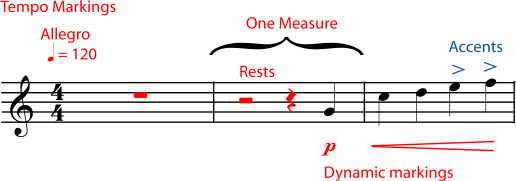
The bar lines divide the staff into short sections
called bars or measures. The notes (sounds) and rests (silences) are the
written music. Many other symbols may appear on, above, or below the
staff, giving directions for how to play the music.
Groups of staves
Figure 1.3. Groups of Staves

(b) When
many staves are to be played at the same time, as in this orchestral
score, the lines for similar instruments - all the violins, for example,
or all the strings - may be marked with braces or brackets.
Clef*
Treble Clef and Bass Clef
Figure 1.4. Treble Clef

A bass clef symbol tells you that the
second line from the top (the one bracketed by the symbol's dots) is F.
The notes are still arranged in ascending order, but they are all in
different places than they were in treble clef.
Figure 1.5. Bass Clef

Memorizing the Notes in Bass and Treble Clef
Figure 1.6.


(b)
You can use a word or silly sentence to help you
memorize which notes belong on the lines or spaces of a clef. If you
don't like these ones, you can make up your own.
Moveable Clefs
Figure 1.7. C Clefs

All of the notes on this staff are middle C.
The bass and treble clefs were also once moveable, but it is now very rare to see them anywhere but in their standard positions. If you do see a treble or bass clef symbol in an unusual place, remember: treble clef is a G clef; its spiral curls around a G. Bass clef is an F clef; its two dots center around an F.
Figure 1.8. Moveable G and F Clefs

It is rare these days to see the G and F clefs in these nonstandard positions.
Much more common is the use of a treble clef that is meant to be read one octave below the written pitch. Since many people are uncomfortable reading bass clef, someone writing music that is meant to sound in the region of the bass clef may decide to write it in the treble clef so that it is easy to read. A very small "8" at the bottom of the treble clef symbol means that the notes should sound one octave lower than they are written.
Figure 1.9.

A small "8" at the bottom of a treble clef means that the notes should sound one octave lower than written.
Why use different clefs?
Figure 1.10.

These
scores show the same notes written in treble and in bass clef. The
staff with fewer ledger lines is easier to read and write.
The G indicated by the treble clef is the G above middle C, while the F indicated by the bass clef is the F below middle C. (C clef indicates middle C.) So treble clef and bass clef together cover many of the notes that are in the range of human voices and of most instruments. Voices and instruments with higher ranges usually learn to read treble clef, while voices and instruments with lower ranges usually learn to read bass clef. Instruments with ranges that do not fall comfortably into either bass or treble clef may use a C clef or may be transposing instruments.
Figure 1.11.

Middle C is above the bass clef and below the treble clef; so together these two clefs cover much of the range of most voices and instruments.
Next


